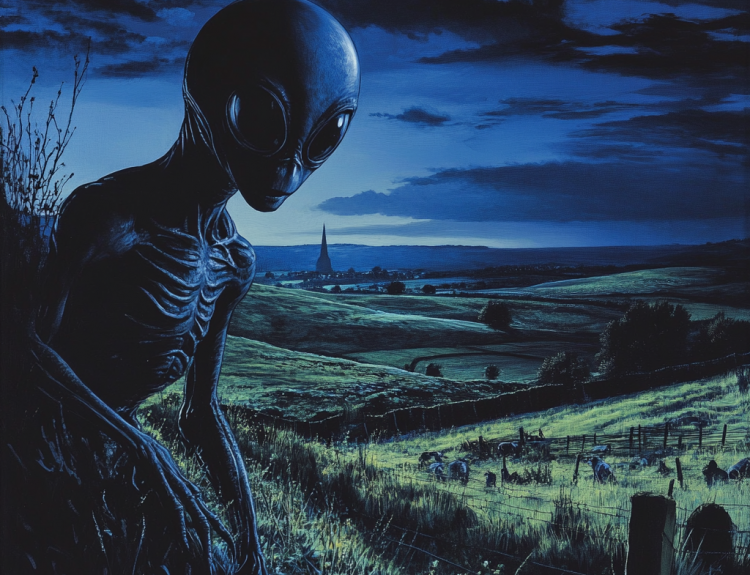

In April 1897, a remarkable story emerged from the small North Texas community of Aurora. According to a report published in the Dallas Morning News, an unidentified airship had crashed into a windmill on the outskirts of the town, killing its mysterious pilot.
The dead pilot, the newspaper reported, was not human.
More than a century later, the Aurora incident has become one of the earliest and most enduring UFO stories in American history. For some, it represents evidence of a genuine encounter with an unknown craft. For others, it is an elaborate piece of frontier folklore—or an outright hoax.
The circumstances surrounding the story, the lack of physical evidence and the questionable provenance of some of its most frequently repeated details have all fuelled the debate.
So what really happened in Aurora, Texas, in 1897?
A Town in Trouble
To understand the story, it is important to consider the circumstances in which it appeared.
Aurora was a small frontier community whose fortunes had begun to decline by the late 19th century. An outbreak of spotted fever had reportedly affected the town, while the arrival of the Fort Worth and Denver City Railway passed Aurora by in favour of other communities.
Population declined, economic prospects weakened and the town faced an uncertain future.
It was against this backdrop that the Aurora airship story appeared.
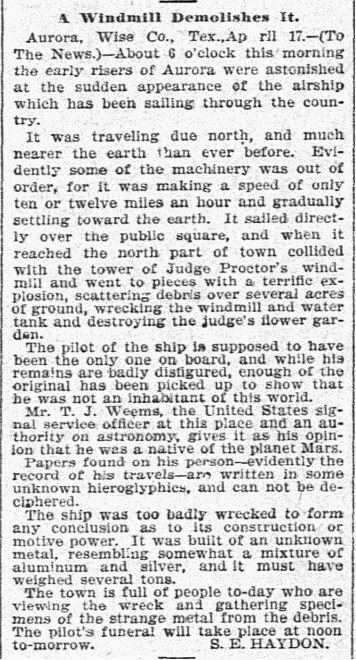
On April 17, 1897, the Dallas Morning News published an account by S. E. Haydon describing an extraordinary incident. According to the report, a mysterious cigar-shaped or airship-like craft had appeared over Aurora before striking a windmill on the property of Judge J. B. Proctor.
The crash reportedly destroyed the windmill and scattered debris across the area.
But the most remarkable detail was still to come.
According to Haydon’s account, the craft’s pilot had been killed in the crash—and appeared to be an inhabitant of another world.
The Mysterious Pilot
The newspaper described the remains as those of a small, unusual humanoid figure. The body was reportedly badly damaged, making its appearance difficult to determine, but the article suggested that the pilot was not a human being.
The story claimed that the mysterious remains were buried in Aurora’s local cemetery.
That detail would become an important part of the legend.
For decades, researchers and UFO enthusiasts have searched for evidence of the alleged grave, hoping that it might provide a tangible link to the events described in 1897.
Yet no universally accepted physical evidence of the pilot or the craft has ever emerged.
That absence lies at the heart of the modern debate.
A Sensational Story in a Sensational Age
The Aurora incident appeared during a remarkable period of technological fascination.
The final years of the 19th century were filled with excitement about new inventions, scientific discoveries and the possibilities of flight. Reports of mysterious “airships” were appearing in newspapers across the United States, particularly during the so-called mystery airship wave of 1896 and 1897.
These reports described strange craft seen travelling through the skies, often years before powered aircraft became a practical reality.
In that environment, the Aurora story was perfectly suited to capture public attention.
A mysterious flying machine crashing into a Texas windmill was remarkable enough. A non-human pilot made the story extraordinary.
For modern researchers, however, this raises an important question: was the story simply an unusual report of something witnesses genuinely believed they had seen, or was it deliberately constructed to attract attention?
The Case for a Hoax
The hoax theory rests on several observations.
Perhaps the most significant is the scarcity of independent evidence.
The original account published by Haydon has become the foundation of much of the Aurora legend. Yet there is little surviving contemporary documentation capable of independently confirming the most extraordinary elements of the story.
There are also questions about the circumstances surrounding the alleged crash site and the fate of the supposed pilot.
If a mysterious craft really had crashed into a windmill and scattered debris across the property, one might expect some physical evidence to have survived. Instead, no artefact has been conclusively authenticated as originating from an extraterrestrial craft.
Likewise, no remains have been scientifically established as belonging to a non-human being.
That does not prove that the story was fabricated. It does, however, make the extraordinary claims difficult to substantiate.
The Economic Motive
One explanation proposed by sceptics is that the story may have been intended to draw attention to a community that desperately needed it.
Aurora was already struggling economically, and an extraordinary event could potentially have brought journalists, visitors and renewed interest to the town.
Whether Haydon or anyone else deliberately fabricated the story for financial or promotional reasons remains unproven. There is no definitive evidence establishing that the people of Aurora organised a hoax specifically to revive the local economy.
Nevertheless, the theory has proved persistent because the timing is suggestive.
A town in decline suddenly becomes the reported site of one of the most extraordinary events imaginable.
Even if the original account began as a joke, exaggeration or piece of sensational journalism, its potential to generate publicity would have been considerable.
Journalism and the Airship Craze
The media environment of the 1890s is another important piece of the puzzle.
Newspapers competed aggressively for readers, and sensational stories could attract considerable attention. The mysterious airships being reported across America provided fertile material for speculation.
The Aurora story emerged directly within this wider fascination.
The distinction between a strange sighting, an unverified rumour and an established news event could easily become blurred as stories were repeated and embellished.
Over time, the Aurora account gained additional details through retelling. As with many pieces of folklore, separating the original report from later additions has become increasingly difficult.
That makes the case particularly challenging for historians.
The Missing Evidence
The alleged alien grave has become one of the most intriguing elements of the story.
According to the original account, the pilot was buried in Aurora’s cemetery, and a grave marker was supposedly placed at the site. Later investigators have searched for evidence of the burial, but no remains have been authenticated as those of an extraterrestrial visitor.
Some researchers have pointed to a small grave marker discovered in the cemetery in the 1940s as a possible connection to the story. Others have argued that the marker’s symbolism and history are insufficient to establish such a connection.
Without identifiable remains, contemporary documentation or authenticated debris, the grave remains an intriguing but inconclusive part of the legend.
Could It Have Been Something Else?
There are several possible explanations for the original report that do not require an extraterrestrial spacecraft.
The object may have been an experimental or conventional aircraft, although the technology required for the described flight was far beyond what was publicly available at the time.
It is also possible that the incident was based on a misidentified natural phenomenon, a misunderstood technological experiment or an ordinary event that became increasingly exaggerated as the story spread.
Alternatively, the entire account could have been fabricated.
There is another possibility that is often overlooked: Haydon and his readers may not have regarded the story in quite the same way modern audiences do. The language and conventions of 19th-century newspaper reporting were different from those of today, and sensational anecdotes could occupy an unusual space between entertainment, local colour and factual reporting.
Without additional contemporary evidence, determining the original intention behind the article is difficult.
The Birth of a UFO Legend
Whatever happened in Aurora, the story acquired a life of its own.
The incident has been revisited repeatedly by UFO researchers, sceptics, journalists and historians. Each generation has brought new interpretations, ranging from claims of an extraterrestrial visitation to explanations based entirely on folklore and sensationalism.
The absence of definitive evidence has paradoxically helped preserve the mystery.
Had the craft been conclusively identified, or had the alleged pilot’s remains been authenticated, the story might have become a historical curiosity rather than a mystery. Instead, the unanswered questions have allowed the Aurora incident to occupy an unusual place in American popular culture.
It is both a historical newspaper story and a UFO legend.
Hoax, Misunderstanding or Something More?
There is no conclusive evidence proving that the Aurora UFO crash was a deliberate hoax.
There is, however, considerable reason to approach the story with caution.
The account rests heavily on a single contemporary newspaper report. No authenticated extraterrestrial remains have been recovered, no debris has been scientifically established as coming from an unknown craft, and the alleged crash has never been independently demonstrated through surviving physical evidence.
At the same time, the absence of evidence does not establish precisely what happened.
The economic difficulties facing Aurora, the popularity of mysterious airship stories and the sensational nature of the newspaper account all provide plausible circumstances in which an ordinary event—or even an invented one—could have developed into an enduring legend.
More than 125 years later, the Aurora incident remains suspended between history and folklore.
Perhaps it was a carefully constructed hoax designed to attract attention to a struggling town. Perhaps it began with a genuine but misunderstood event and grew through years of embellishment. Or perhaps the original report recorded something that has yet to be satisfactorily explained.
What can be said with greater certainty is that the story demonstrates the extraordinary power of a good mystery.
A small Texas town, a mysterious craft, an alleged visitor from another world and a grave whose secrets have never been settled—these ingredients were enough to create a legend that has survived for more than a century.
And whether the Aurora UFO crash was an elaborate deception or simply an extraordinary story from an extraordinary era, its place in the history of UFO folklore appears secure.