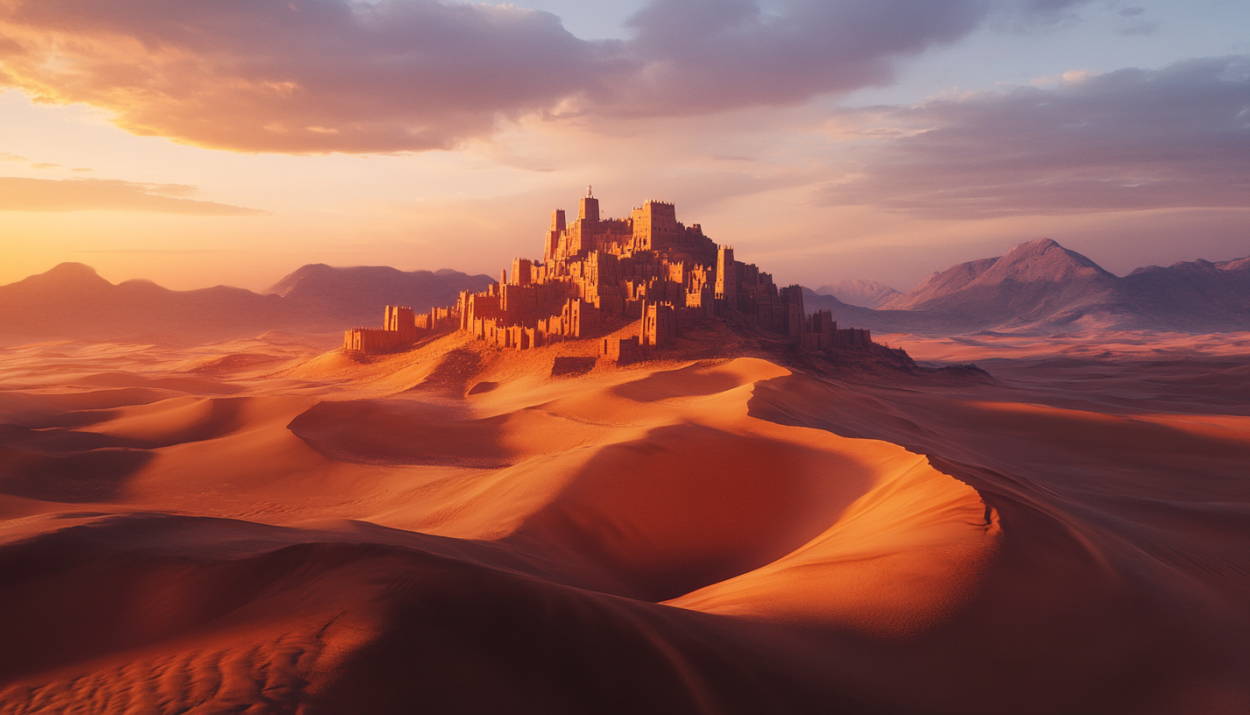
Few stories capture the romance of exploration quite like the search for Zerzura, the legendary lost city said to lie somewhere deep within the Sahara Desert.
At the centre of that story was László Almásy, a Hungarian-born aviator and explorer whose fascination with the desert took him into some of the most remote and inhospitable landscapes in North Africa.
His expeditions would take him across vast stretches of the Libyan Desert, where he mapped unexplored territory, documented prehistoric rock art and helped reveal a Sahara very different from the endless sea of sand imagined by much of the outside world.
He never found Zerzura.
Yet his search for the fabled city became one of the great adventure stories of the 20th century—and decades later, Almásy’s life would provide inspiration for the central character of Michael Ondaatje’s novel The English Patient and its celebrated film adaptation.
But behind the fiction was a real explorer, a real desert and a mystery that had captivated adventurers for generations.
The Making of an Explorer
László Almásy was born in Hungary in 1895. From an early age, he was fascinated by the emerging possibilities of aviation and the unexplored corners of the world.
The aeroplane was still a relatively new invention, but Almásy quickly recognised its potential for exploration. During the First World War, he served as a pilot, gaining experience that would later prove invaluable in the deserts of North Africa.
After the war, his interests increasingly turned towards the Sahara.
The desert presented a formidable challenge. Vast areas remained poorly mapped, and travelling across them by conventional means could be extremely difficult. Aircraft offered explorers an entirely new perspective—and Almásy became one of the pioneers of using aviation to investigate the remote regions of the Libyan Desert.
There were also stories.
Among them was the legend of Zerzura.
The Legend of the White City
Zerzura was said to be a mysterious oasis or lost city hidden somewhere in the Sahara. In some versions of the legend, it was described as a beautiful, fertile settlement surrounded by gardens and water.
It was sometimes referred to as the “White City”.
The story’s origins are obscure, and accounts of Zerzura varied considerably. Some versions were linked to an alleged manuscript describing a lost settlement, while others appear to have developed through oral traditions and the retelling of travellers’ tales.
For explorers fascinated by the unknown, however, the possibility was irresistible.
Could an oasis really exist in one of the world’s harshest environments?
Almásy wanted to find out.
Into the Libyan Desert
Beginning in the late 1920s, Almásy undertook expeditions into regions of the Sahara that were barely known to Europeans.
In 1929, he worked with Egyptian Prince Kemal el Din Hussein, an important figure in the exploration of the Western Desert. Together, they investigated areas around the Gilf Kebir, a vast sandstone plateau close to the modern borders of Egypt, Libya and Sudan.
From the air, Almásy could explore terrain that would have been extraordinarily difficult to reach by ground.
Deep valleys, towering sandstone formations and hidden wadis emerged from the landscape.
Although the expedition did not uncover Zerzura, it demonstrated that the Sahara contained landscapes capable of sustaining life under the right conditions.
For Almásy, this was an important clue.
The desert was not always the desert.
A Sahara of Green Valleys
The 1930s represented the high point of Almásy’s exploratory career.
During expeditions across the Gilf Kebir and Jebel Uweinat region, he and other explorers encountered evidence that the Sahara had once been dramatically different.
On remote rock faces were paintings depicting cattle, people, wildlife and figures apparently swimming.
The discoveries offered a remarkable glimpse into a distant past when parts of what is now one of the world’s driest regions were considerably wetter and more hospitable.
The paintings suggested that prehistoric communities had lived in landscapes that bore little resemblance to the Sahara of the modern era.
For Almásy, they also added another layer to the mystery of Zerzura.
If human beings had once inhabited these remote valleys, could an oasis civilisation—or at least the memory of one—have survived in desert folklore?
The Cave of the Swimmers
Among the most famous discoveries associated with Almásy’s expeditions was a rock shelter containing prehistoric paintings of figures that appeared to be swimming.
The site became known as the “Cave of the Swimmers”.
The paintings were compelling evidence of the Sahara’s dramatically different ancient climate and became an important part of Almásy’s writings about the region.
In 1936, he published The Unknown Sahara, describing his expeditions and discoveries and helping to bring the mysteries of the Libyan Desert to a wider audience.
The book also helped keep the legend of Zerzura alive.
Yet despite his extensive exploration, Almásy never found the mythical White City.
The Lost City That Remained Lost
For all the romance surrounding Zerzura, there is no established archaeological evidence that a city matching the legend ever existed.
That has not stopped generations of explorers and enthusiasts from searching for it.
One explanation is that the story may have been based on a real oasis or settlement that was exaggerated through repeated retelling. Another is that Zerzura was entirely mythical, a product of desert folklore and the imagination of explorers hungry for the next great discovery.
There is also a more intriguing possibility: that fragments of genuine geographical knowledge became transformed into a legend over time.
Whatever its origins, Zerzura provided Almásy with a reason to venture into some of the least accessible landscapes on Earth.
And in doing so, he discovered something arguably more important than a lost city.
He discovered a lost landscape.
War in the Desert
Almásy’s legacy, however, cannot be separated from the events that followed.
When the Second World War began, his knowledge of the Sahara made him valuable to the Axis powers. He served with German forces in North Africa as an intelligence officer and pilot, undertaking missions connected with the war in the desert.
His wartime activities have complicated his reputation as an explorer.
The same knowledge of the terrain that had previously been used for exploration could now be used for military purposes. His understanding of remote routes and desert geography became strategically valuable during the conflict between Axis and Allied forces.
The romantic image of the lone desert explorer therefore tells only part of Almásy’s story.
A Legacy Written in Sand
László Almásy died in 1951, but his name remains closely associated with the great mysteries of the Sahara.
He never found Zerzura.
What he did find was arguably more significant: evidence of ancient human activity, prehistoric rock art and landscapes that challenged conventional ideas about the history of the Sahara.
His expeditions helped map and document enormous areas of remote desert and demonstrated the extraordinary value of aviation as a tool of exploration.
The search for Zerzura may ultimately have been unsuccessful, but it led Almásy into places few outsiders had ever seen.
That is perhaps the enduring appeal of the story.
The lost city remains lost, its existence unproven and its location unknown. But the search for it opened a window onto a much older Sahara—a world of green valleys, flowing water and prehistoric communities that existed thousands of years before the desert became the landscape we know today.
In that sense, Almásy never found the city he was looking for.
Instead, he uncovered a forgotten world.
And for an explorer, perhaps that was the greater discovery.