The 1960s–1980s: UFOs Enter the Mainstream
By the 1960s, humanity’s relationship with the sky was changing dramatically.
The Space Race had transformed the heavens from a realm of mythology into a new frontier of exploration. As the United States and Soviet Union competed to reach beyond Earth, public fascination with other worlds grew alongside the rockets carrying astronauts into orbit.
Then, in 1969, humanity reached the Moon.
The achievement was a defining moment of the twentieth century, but it also intensified an enduring question: if human beings could travel to another world, could someone—or something—from another world have already come here?
Popular culture quickly embraced the possibility.
Steven Spielberg’s Close Encounters of the Third Kind, released in 1977, offered audiences a strikingly different vision of extraterrestrial contact. Rather than depicting aliens solely as invaders or monsters, the film imagined communication, curiosity and even wonder. Its unforgettable sequences of luminous spacecraft and the haunting musical exchange between humans and extraterrestrials helped establish the film as a landmark of science fiction.
Close Encounters became both a critical and commercial success, earning multiple award nominations and taking more than $300 million worldwide. More importantly, it helped transform the UFO from a symbol of fear and conspiracy into something more complex: a potential messenger from another world.
Meanwhile, reports of unexplained aerial phenomena continued to emerge from military personnel, commercial and military pilots, police officers and civilians. The credibility of some witnesses—particularly those with professional experience in aviation and the armed forces—helped sustain public interest even as skeptics questioned the reliability of individual accounts.
The decade also saw the rise of a more radical interpretation of humanity’s relationship with extraterrestrial life.
In 1968, Swiss author Erich von Däniken published Chariots of the Gods?, arguing that technologically advanced extraterrestrial visitors may have reached Earth in the distant past and influenced the development of early civilizations. The book became an international bestseller and introduced ancient-astronaut theory to a mass audience.
Whether regarded as provocative speculation or pseudoscience, the theory proved extraordinarily influential. It encouraged readers to reinterpret ancient monuments, religious traditions and mysterious archaeological artifacts through an extraterrestrial lens.
By the end of the 1970s, UFOs were no longer confined to the margins of popular culture. They had become part of the mainstream imagination.
The 1990s–2000s: Government Secrecy and UFOs Become a Cultural Staple
If the 1970s made UFOs commercially irresistible, the 1990s made them inseparable from conspiracy culture.
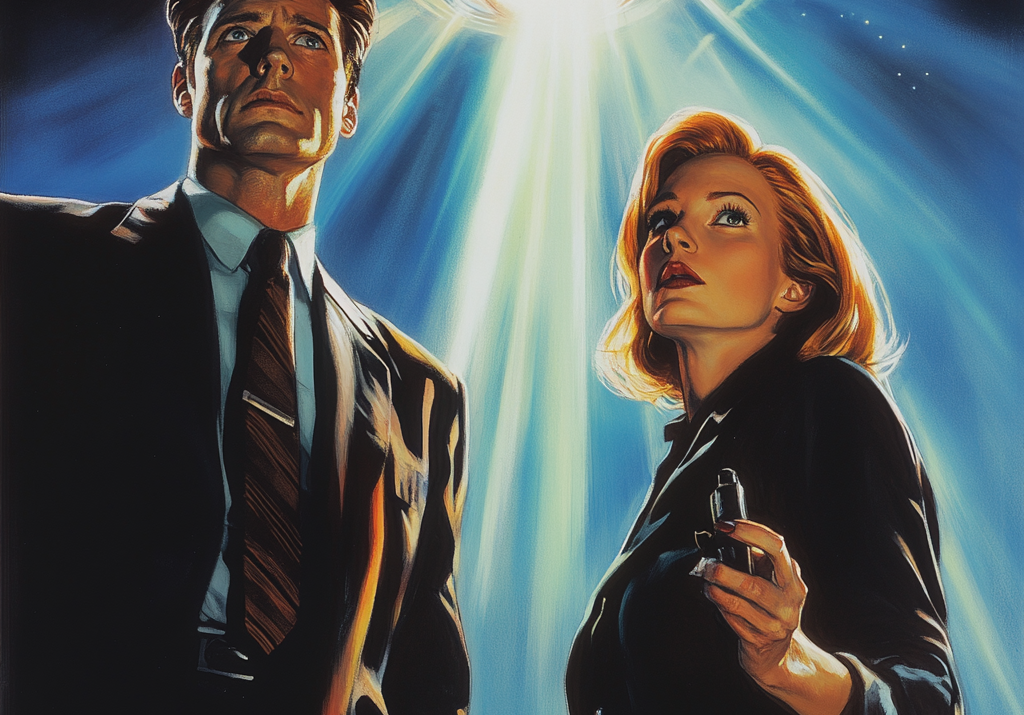
Few television programs captured the mood of the decade more effectively than The X-Files, which premiered on September 10, 1993. Combining UFO mythology, government conspiracies, paranormal phenomena and crime drama, the series followed FBI agents Fox Mulder and Dana Scully as they investigated cases that challenged conventional explanations.
Its central premise was encapsulated in a phrase that became synonymous with the era:
“The Truth Is Out There.”
The slogan resonated with an audience increasingly fascinated by the possibility that governments knew more about UFOs than they were willing to reveal. The show’s influence extended far beyond television, turning UFO mythology and government secrecy into familiar elements of global popular culture.
At the same time, declassified documents and reports concerning military investigations into unexplained aerial phenomena continued to fuel speculation. For believers, the release of previously secret material seemed to reinforce the argument that authorities had been withholding information. For skeptics, the documents often demonstrated something more mundane: governments had investigated unusual sightings without necessarily concluding that they were extraterrestrial.
Hollywood, meanwhile, embraced the phenomenon with enthusiasm.
Independence Day (1996) transformed alien invasion into a spectacular blockbuster, imagining an extraterrestrial assault on Earth on a scale previously unseen. A year later, Men in Black (1997) took the mythology in an entirely different direction, combining government secrecy, extraterrestrials and comedy.
Together, films such as these helped make the UFO a permanent fixture of the entertainment landscape.
By the turn of the millennium, alien visitors were no longer the preserve of UFO enthusiasts. They had become part of the cultural vocabulary.
UFOs in the Digital Age: The 2010s to the Present
The arrival of the internet changed the UFO phenomenon once again.
For decades, information about UFO sightings had circulated through books, magazines, television programs and specialist organizations. The digital revolution eliminated many of those barriers.
Suddenly, anyone with a camera and an internet connection could document an unexplained object and share it with millions of people.
Online forums, social-media platforms, podcasts and YouTube channels created vast communities dedicated to analysing photographs, videos and eyewitness accounts. A single unexplained image could travel around the world within hours, generating theories, counter-theories and amateur investigations.
Then came a development that dramatically altered the conversation.
In 2017, reports surrounding the Pentagon’s Advanced Aerospace Threat Identification Program (AATIP) brought renewed attention to the government’s investigation of unexplained aerial phenomena. Around the same period, officially released military videos appeared to show encounters with objects that pilots and military personnel had been unable to immediately identify.
The terminology itself began to change.
“UFO” increasingly gave way to UAP—Unidentified Anomalous Phenomena—a broader term intended to describe observations that could not readily be identified. The shift reflected a changing institutional approach: rather than beginning with the assumption that an object was extraterrestrial, investigators could acknowledge that something had been observed without prematurely deciding what it was.
Popular culture continued to explore the possibilities.
The television series Ancient Aliens kept ancient-astronaut theories in the public eye, while films such as Denis Villeneuve’s Arrival (2016) approached extraterrestrial contact through language, communication and philosophy rather than conventional invasion narratives.
Jordan Peele’s Nope (2022) offered yet another perspective, examining humanity’s complicated relationship with spectacle, technology and the desire to capture the extraordinary on camera.
Meanwhile, UFOs moved increasingly into the political and governmental sphere. Congressional hearings in the United States brought military witnesses and UAP investigations into public view, transforming a subject once associated largely with fringe communities into a matter of serious institutional discussion.
That does not mean governments have confirmed the existence of extraterrestrial spacecraft. They have not.
But the distinction is important: acknowledging that some aerial observations remain unexplained is not the same as declaring them alien.
From Flying Saucers to UAPs
The history of UFO culture is, in many ways, a history of changing language.
The “flying saucer” of the 1950s became the extraterrestrial visitor of science fiction, the government secret of the conspiracy era and, eventually, the UAP of the digital age.
What has remained constant is the question behind all of them.
Are we alone?
For generations, the UFO has provided a canvas onto which humanity projects its hopes, fears and uncertainties. At different moments, extraterrestrials have represented technological progress, divine intervention, military threats, government deception or the possibility of discovering intelligent life beyond Earth.
Today, the conversation sits at an intriguing intersection of science, entertainment, politics and popular culture.
The mystery has changed.
The fascination has not.