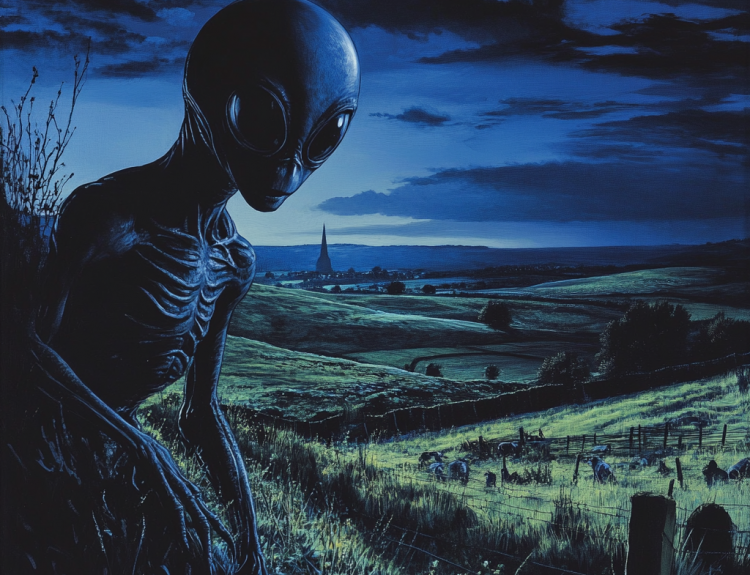
Deep in Transylvania, on the outskirts of Cluj-Napoca, lies a forest with a reputation unlike almost any other.
The Hoia-Baciu Forest has been described as Romania’s answer to the Bermuda Triangle—a place associated with unexplained disappearances, strange lights, UFO sightings and a long tradition of supernatural folklore.
For decades, visitors have reported unsettling sensations, unexplained sounds and unusual phenomena among its trees. Stories of ghosts and mysterious figures have become intertwined with tales of UFOs, strange photographs and an enigmatic circular clearing where, according to local legend, little seems willing to grow.
Whether these stories are evidence of something genuinely unexplained or the product of folklore, suggestion and an unusual landscape, Hoia-Baciu has become one of Europe’s most famous destinations for those fascinated by the paranormal.
But the forest’s mystery did not begin with modern UFO sightings.
Its story stretches back much further.
An Ancient and Mysterious Landscape
Long before the region became associated with ghosts and flying saucers, the forest formed part of the landscape inhabited by the Dacians, the ancient people who occupied much of what is now Romania before the Roman conquest.
The Dacians left relatively few written records, making it difficult to establish precisely how they regarded the forest. However, archaeological evidence demonstrates that settlements existed in the surrounding region, and later traditions have contributed to the idea that the landscape held religious or spiritual significance.
In AD 106, the Romans conquered Dacia and incorporated much of the territory into the Roman Empire.
Roads, settlements and military installations were constructed throughout the region. Yet the dense woodland that would eventually become known as Hoia-Baciu remained relatively undeveloped compared with more accessible areas.
Over the centuries, different peoples passed through Transylvania, and forests naturally became places of refuge, travel and folklore. Stories of people disappearing into the woods were not unusual, particularly in an era when remote forests could be genuinely dangerous places.
Over time, such stories became part of the mythology surrounding Hoia-Baciu.
The Story Behind the Name
The origins of the name Hoia-Baciu are themselves connected to local folklore.
One of the most frequently repeated stories concerns a shepherd named Baciu who is said to have entered the forest with a flock of approximately 200 sheep and never returned.
There is no reliable historical evidence establishing that this particular incident occurred, but the story has become deeply embedded in the forest’s mythology.
The name itself combines “Hoia”, associated with the nearby area, with “Baciu”, the name of the legendary shepherd.
Today, the forest covers roughly 300 hectares and is remarkable for another reason: its trees often appear unusually twisted and contorted.
Some trunks bend dramatically, while branches grow at strange angles, producing shapes that can look almost unnatural.
For visitors unfamiliar with the landscape, the effect can be unsettling.
And in a forest already surrounded by stories of ghosts and disappearances, unusual trees can become something more than botanical curiosities.
They become part of the legend.
The Circular Clearing
Perhaps no feature of Hoia-Baciu has generated more speculation than the circular clearing known as Poiana Rotundă.
Unlike the surrounding woodland, the clearing is largely open, creating an almost perfectly defined space among the trees.
According to paranormal lore, the clearing is a hotspot for unusual activity. Visitors have reported feelings of being watched, unexplained lights and other sensations that they have interpreted as evidence of something beyond the ordinary.
Some accounts have even linked UFO sightings to the area.
One of the enduring questions is why trees do not appear to grow across parts of the clearing in the same way as they do in the surrounding forest.
Various explanations have been proposed, ranging from soil conditions and natural variations in vegetation to much more extraordinary claims involving electromagnetic energy or other unexplained forces.
Despite decades of speculation, there is no established scientific evidence that the clearing is caused by paranormal activity.
Yet its unusual appearance has undoubtedly contributed to the forest’s reputation.
The 20th-Century Mystery
By the middle of the 20th century, Hoia-Baciu was already surrounded by local stories. But it was during the 1960s that the forest began attracting attention beyond Romania.
Among the figures associated with the forest was Alexandru Sift, a biologist who reportedly investigated unusual phenomena in the area and photographed objects and lights that he considered difficult to explain.
His work helped establish the forest’s modern reputation as a location of unexplained phenomena.
Then came the photograph that would transform Hoia-Baciu into an international UFO story.
The Famous UFO Photograph
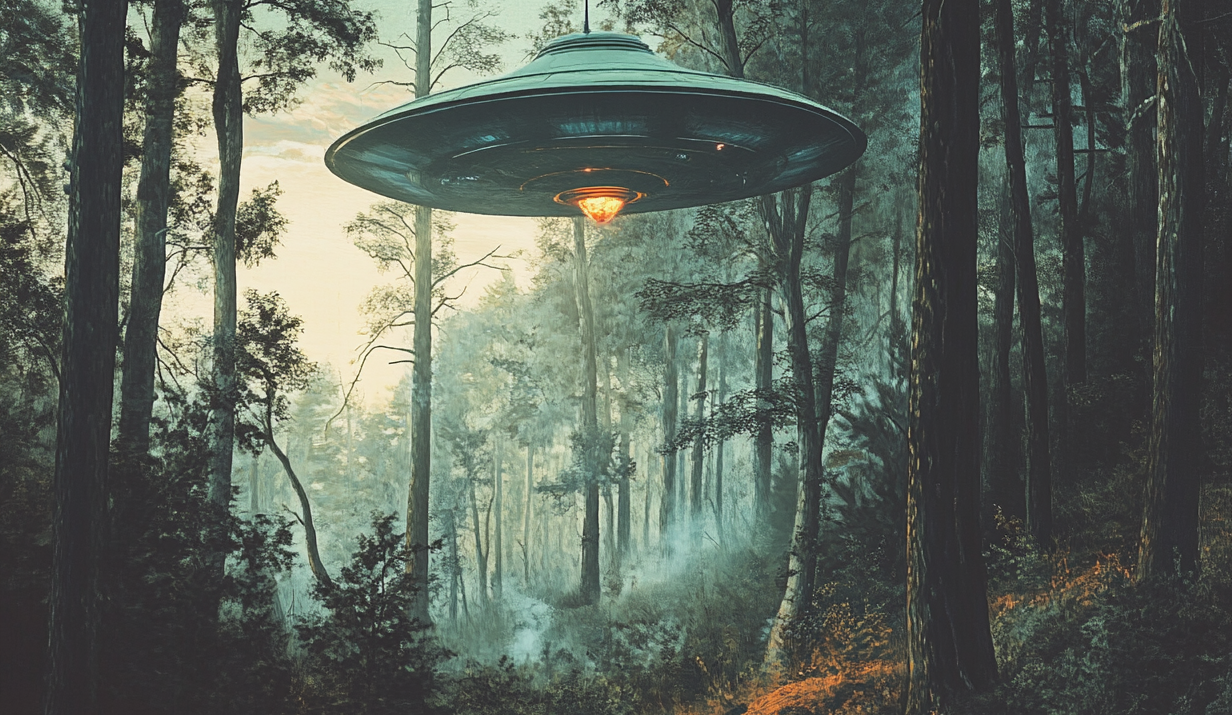
In 1968, Romanian forester and photographer Emil Barnea was reportedly visiting the forest with several companions when he saw what he described as an unidentified object in the sky.
Barnea took a photograph.
The resulting image appears to show a disc-shaped object suspended above the treeline.
The photograph quickly became one of the most famous UFO images associated with Romania. To believers, it represented compelling photographic evidence of an unidentified craft. To sceptics, however, the image is far less conclusive, with questions surrounding its interpretation, provenance and the possibility of more conventional explanations.
Whatever the truth, the photograph gave Hoia-Baciu a new identity.
The forest was no longer simply a place associated with local ghosts and legends.
It had become a destination for UFO enthusiasts.
Behind the Iron Curtain
There is another reason the forest’s reputation grew so dramatically in the second half of the 20th century.
During the communist period, Romania was part of the Eastern Bloc, and travel and information from the country were more restricted than they would be today.
For audiences in Western Europe and North America, Romania was relatively distant and unfamiliar.
Stories emerging from the forest therefore acquired an additional sense of mystery.
Rumours were difficult to investigate independently, photographs were difficult to verify and extraordinary stories could circulate for years without being subjected to close outside scrutiny.
That distance helped transform local folklore into something larger.
Disappearances and the Stories of the Forest
Perhaps the most extraordinary stories associated with Hoia-Baciu concern people who supposedly vanished within its boundaries.
One particularly dramatic legend tells of a young girl who disappeared in the forest despite an extensive search. According to the story, she returned years later wearing the same clothes and with no memory of what had happened to her.
The tale has been interpreted by some as evidence of a portal or gateway to another dimension.
It is an extraordinary story.
It is also important to recognise that there is no reliable evidence establishing that such an event occurred as described.
Stories of mysterious disappearances have a long history, particularly in places where forests are difficult to search and where folklore has already created an expectation of the supernatural.
Over time, a missing-person story can become something considerably more elaborate.
In Hoia-Baciu, those stories have become part of the forest’s identity.
Ghosts, UFOs and the Power of Suggestion
The supernatural reputation of Hoia-Baciu encompasses much more than UFOs.
Visitors have reported strange noises, unexplained lights, unusual sensations and the feeling of being watched. Some have claimed to experience headaches, dizziness or other physical sensations while inside the forest.
Paranormal investigators have interpreted some of these experiences as evidence of unusual energy or unexplained forces.
Sceptical explanations are considerably more conventional.
A dense forest with unusual tree formations, shifting light, unfamiliar sounds and limited visibility can affect how people perceive their surroundings. Expectations also matter. Someone entering Hoia-Baciu expecting to encounter something strange may be more likely to interpret an ambiguous sound, movement or light as evidence of something extraordinary.
Psychologists refer to related processes in terms such as expectation, suggestion and perceptual bias.
In other words, the forest may not need to contain anything supernatural to produce genuinely unsettling experiences.
The feeling of fear can be very real even when its cause is entirely natural.
Searching for an Explanation
Over the years, researchers, paranormal investigators and UFO enthusiasts have attempted to find physical explanations for the stories surrounding Hoia-Baciu.
Claims have circulated about unusual electromagnetic activity and other environmental anomalies. However, extraordinary claims require reliable, repeatable evidence, and there is currently no established scientific explanation demonstrating that the forest is a centre of paranormal or extraterrestrial activity.
Natural explanations may account for many of the forest’s peculiarities.
The unusual appearance of the trees can result from growth patterns, environmental conditions and the way individual trees respond to their surroundings. The circular clearing may likewise have ecological or geological explanations rather than supernatural ones.
Yet science has not erased the mystery entirely.
It has simply shifted the question.
Instead of asking whether the forest is haunted, perhaps the more interesting question is why humans are so readily captivated by places that feel different.
Hoia-Baciu Today
Today, Hoia-Baciu is a popular destination for visitors interested in nature, folklore, photography and the paranormal.
Guided tours introduce visitors to the forest’s history and the stories that have accumulated around it. Documentaries, television programmes and online videos have brought its most famous legends to an international audience.
The result is a curious mixture of natural landscape and cultural mythology.
There is the forest itself—with its unusual trees, clearings and atmosphere—and then there is the forest as imagined through decades of stories.
Separating the two can be difficult.
Perhaps that is precisely what makes Hoia-Baciu so compelling.
A Forest Between Reality and Legend
There is no shortage of extraordinary stories associated with Hoia-Baciu: ghosts, UFOs, unexplained lights, strange photographs, mysterious disappearances and tales of portals to other worlds.
But the evidence behind those stories varies considerably.
Some have clear origins in local folklore. Others are based on eyewitness testimony or photographs whose interpretations remain disputed. Many have grown considerably more elaborate through years of retelling.
That does not make the forest any less fascinating.
If anything, it makes Hoia-Baciu an intriguing example of how landscapes acquire identities of their own.
A twisted tree becomes a sign of something unnatural. A clearing becomes a paranormal hotspot. An unusual light becomes a UFO. A disappearance becomes a story of another dimension.
Over time, the stories become inseparable from the place.
Whether Hoia-Baciu is genuinely mysterious or simply extraordinarily good at inspiring mystery is a question each visitor must answer for themselves.
What is beyond dispute is that deep among the trees of Transylvania, reality and folklore have become remarkably difficult to separate.
And perhaps that is the forest’s greatest mystery of all.