Of the many alleged UFO encounters reported during the 20th century, few have attracted as much fascination as the Ilkley Moor alien sighting. The combination of a seemingly credible witness, a remarkable account, a mysterious photograph and the atmospheric setting of the Yorkshire moors has elevated the case to almost legendary status.
But what really happened on a cold winter morning in 1987, on the stretch of moorland between the West Yorkshire towns of Ilkley and Keighley? More than three decades later, the answer remains elusive.
What Happened?
On the morning of December 1, 1987, a retired police officer known publicly as Philip Spencer—although this is not his real name—set out to walk across Ilkley Moor. He was alone, carrying a camera to photograph the early morning landscape and a compass in case he became disoriented in the fog, which was common on the moors at that time of year.
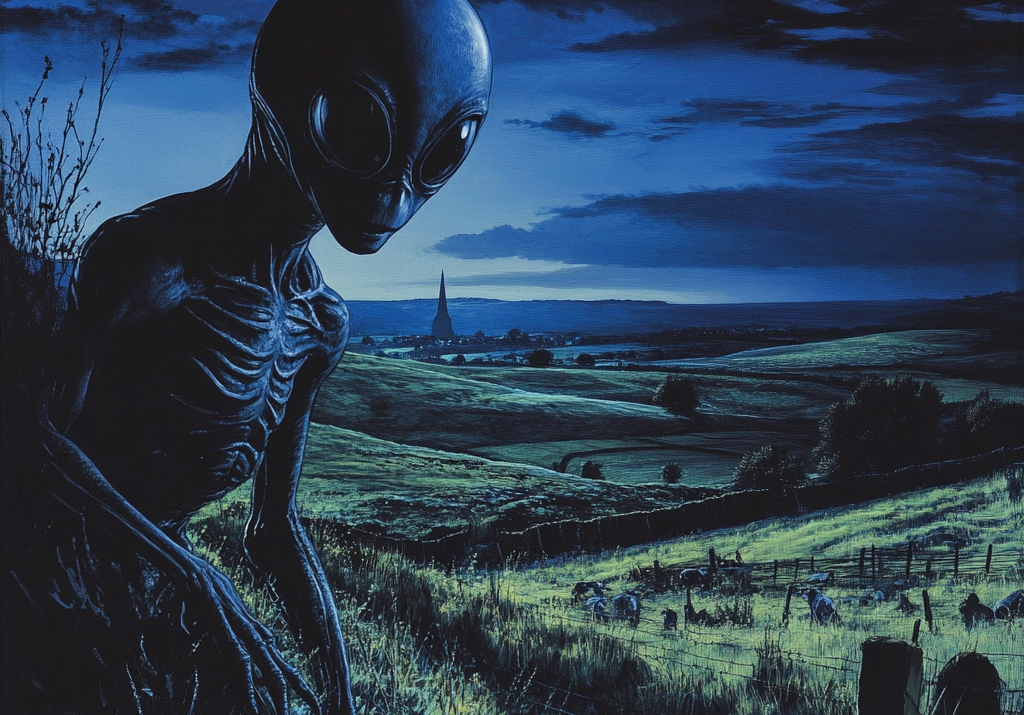
According to Spencer, his walk took an extraordinary turn when he encountered an unusual figure standing on the moor. He described the creature as approximately four feet tall, with greenish skin, long, slender arms and an unusually large head.
Spencer managed to photograph the figure. He later said that the creature gestured towards him, which he interpreted as a warning to stay away. Despite this, he followed it for a short distance.
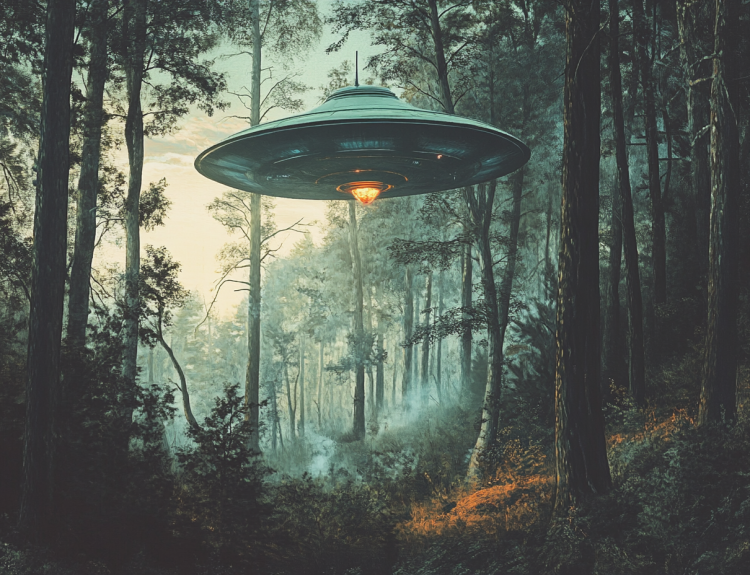
He then claimed to have witnessed a saucer-shaped craft rising from the moor and disappearing into the distance, accompanied by a loud humming sound.
When Spencer eventually made his way to his father-in-law’s house, he realised that considerably more time had passed than he had initially thought. There was another puzzling detail: his compass appeared to be pointing in the wrong direction.
What began as an unusual walk across the moors had become an encounter that would attract the attention of UFO investigators and enthusiasts around the world.
The Follow-Up Investigation
After the encounter, Spencer contacted UFO investigators and submitted the photograph he had taken. Several months later, in March 1988, he agreed to undergo a session of regressive hypnosis in an attempt to uncover memories of events he believed he had experienced but could not consciously recall.
During the session, Spencer described being paralysed and taken aboard the mysterious craft. He claimed that the occupants subjected him to medical procedures before showing him two films.
One allegedly depicted apocalyptic scenes, while the contents of the second have never been publicly revealed in detail.
According to the account produced during the hypnosis session, Spencer was eventually returned to the moor. The beings then gestured towards him once again, a gesture he interpreted as a farewell.
The hypnosis session added another extraordinary layer to an already unusual story—but it also introduced new questions about the reliability of Spencer’s recollections.
The Investigation
One of the most intriguing aspects of the case is the photograph itself. Investigators examined the entire roll of film taken by Spencer, yet only one frame appeared to show the alleged creature. The remaining photographs were consistent with a solitary walk across the moor in the early morning.
For supporters of the case, the photograph remains its most compelling piece of evidence. Although the figure is some distance from the camera, its apparent shape corresponds broadly with Spencer’s description. The photograph was also taken alongside other images on the same roll, apparently under similar conditions, which has been cited as evidence against the idea that the image was simply inserted or manipulated.
It is worth remembering, however, that the photograph predates the widespread availability of digital image-editing software such as Photoshop. That fact has often been emphasised by those who regard the photograph as difficult to explain, although the absence of digital manipulation does not, by itself, establish what the image actually depicts.
Another important element of the case is Spencer himself. Although he has maintained his anonymity, his background as a retired police officer has often been cited by supporters as a reason to take his account seriously. He also apparently received no obvious financial benefit from reporting the encounter.
None of this, however, provides definitive proof of what happened.
Critics have highlighted the photograph’s limitations, particularly its poor quality, the distance between the camera and the figure, and the difficult lighting conditions. Under such circumstances, it is possible that the image could depict a person, an animal or another object rather than an unknown creature.
There is also no photograph of the alleged saucer-shaped craft—an absence that raises an obvious question. If Spencer had a camera with him and encountered both a strange creature and an unidentified craft, why is there only one photograph of the creature and none of the craft?
The hypnosis evidence is similarly contentious. Regressive hypnosis is widely regarded as an unreliable method of recovering accurate memories, and critics have argued that it can encourage the creation or alteration of memories rather than simply uncovering forgotten events. Changes or inconsistencies in Spencer’s account during the hypnosis session have therefore become another point of debate.
Importantly, the hypnosis session cannot independently establish whether Spencer’s original encounter occurred. Nor can its unreliability, by itself, demonstrate that the entire story was fabricated.
Alternative Explanations
If the creature was not an extraterrestrial being, what else might Spencer have encountered?
One possibility is that the incident was a hoax—either one carried out on Spencer or one in which he knowingly participated. Another explanation is considerably less elaborate: the figure in the photograph may simply have been a person wearing unusual clothing or a costume.
The poor quality of the image leaves considerable room for interpretation. A fleeting glimpse of an unfamiliar figure, encountered in foggy and unfamiliar surroundings, could potentially have been transformed in the mind of the witness into something far more extraordinary.
The landscape itself may also have played a role. Ilkley Moor is an isolated and often atmospheric environment, particularly in winter. Fog, unusual rock formations, changing light and the sense of solitude can make an otherwise ordinary scene appear strange or unfamiliar.
There remains one particularly persistent question: why did Spencer take only a single photograph of the alleged creature, and none of the craft?
For a witness confronted with what he believed to be an extraordinary encounter, the lack of additional photographs is difficult to reconcile with the circumstances—although it cannot, on its own, determine whether his account was genuine.
The hypnosis session provides another source of uncertainty. Because of the controversy surrounding the reliability of regressive hypnosis, memories recalled under such circumstances cannot necessarily be treated as an accurate record of past events. The changing details of Spencer’s story have consequently become an important part of the debate surrounding the case.
Even without an obvious financial motive, there are numerous possible reasons why someone might create or embellish an extraordinary story. Perhaps the account began as a misunderstanding, perhaps it was deliberately fabricated, or perhaps Spencer genuinely believed that he had experienced something inexplicable.
More than three decades later, the evidence does not provide a definitive answer.
Legacy and Impact
Despite the criticism surrounding the case, the Ilkley Moor alien remains one of Britain’s best-known alleged UFO encounters. It has been discussed alongside other prominent cases and continues to attract interest precisely because it contains something more tangible than an eyewitness account: a photograph.
The case has all the ingredients of a classic UFO mystery—a solitary witness, an isolated landscape, an unexplained photograph, an alleged encounter with strange beings and a series of extraordinary memories recalled under hypnosis.
At the heart of it all is that single image: eerie, ambiguous and open to interpretation.
For those who believe Spencer encountered something genuinely inexplicable, the photograph represents a tantalising piece of physical evidence. For sceptics, its indistinct nature makes it far more likely to have an ordinary explanation.
Perhaps that ambiguity is the reason the story has endured.
The Ilkley Moor encounter has never been conclusively proven to be an extraterrestrial event, but neither has the photograph provided an explanation that has satisfied everyone. And so the mystery remains—rooted in one cold morning on the Yorkshire moors, preserved in a single enigmatic photograph and kept alive by a question that has never quite gone away:
What, exactly, did Philip Spencer see on Ilkley Moor?